Sono Lino director Jacob Patrick on getting 'spoiled' by 'working with the Michael Jordan of glass'
"As long as you keep learning, you have the means to keep creating"

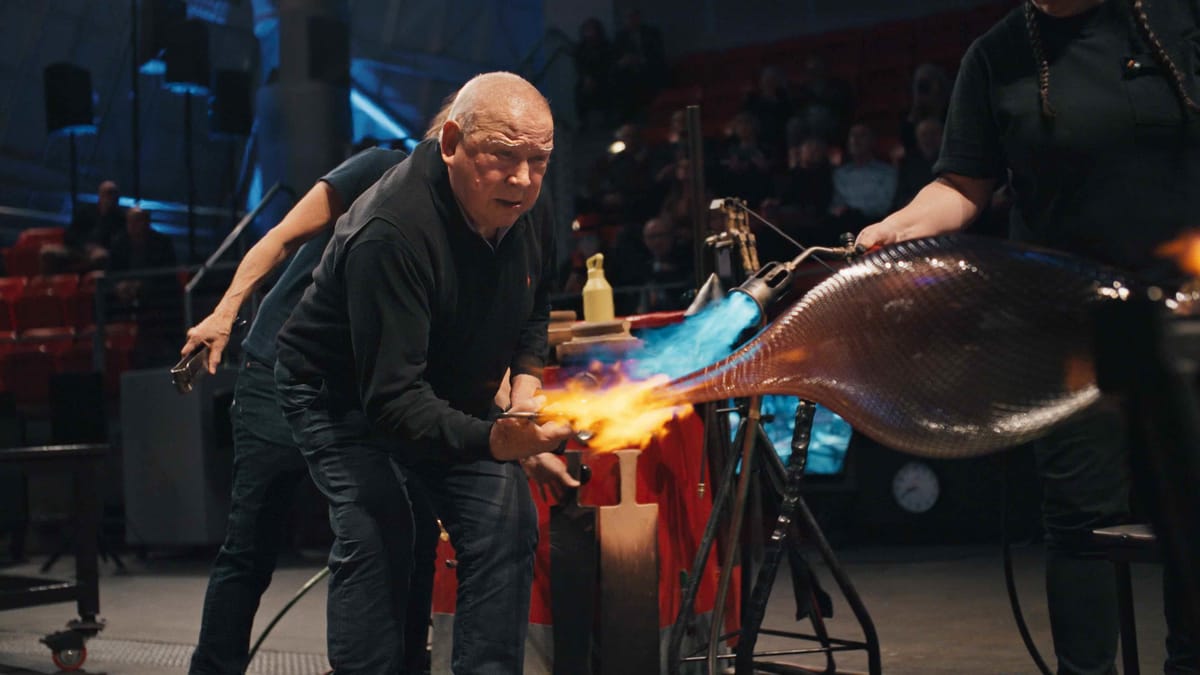
After a warm reception on the festival circuit last fall, Jacob Patrick’s documentary Sono Lino, about legendary glassblower Lino Tagliapietra, is finally getting a wider release. Amalgamation Pictures will be releasing the film on Sonolino.com on December 19, with a 20 minute never-before-seen bonus chapter.
Sono Lino studies a fascinating artist who changed the art of glassblowing globally. Tagliapietra started blowing glass at the age of 11 after dropping out of school to work at a factory, and performed the craft professionally for 75 years. His reputation as an artist didn’t fully blossom until he was 40 years into his career – one of the most interesting elements of Sono Lino is where the line gets drawn between laborer and artist, and how blurry that distinction can get.
Tagliapietra is a larger-than-life figure who still has many ideas for glass projects (including an over 10-foot tall dinosaur), but the work is now too physically intense and dangerous for him to perform regularly. The movie focuses on where he goes from here (“Take it easy? I try. Doesn’t work.”) as well as the legacy carried by his many students, and the community forged around the work.
I spoke with director Patrick about the project’s genesis, stumbling into a love for documentaries, why the artisanship of any craft is valuable, and the infectious work ethic of Tagliapietra.
This interview has been lightly edited for length and clarity.

When and how did documentary filmmaking start for you?
I started in documentaries almost as a simple means to create when I was early in my career. It was an avenue that was, I guess, more available in the sense of picking up a camera and going. I remember asking another director buddy really early on, Hey, what are you doing to make money? He said I do a lot of shortform doc content, which back then wasn’t nearly as popular as it is now, like with branded content.
So I just started shooting. I started picking up a camera and doing it all myself: direct, shoot, edit, produce, the whole nine. And I kind of stumbled into a love for it. That’s probably the most apt way to describe it.
There's a beautifully selfish aspect to documentary storytelling – follow doc storytelling, archive doc is completely different. But the selfish element is you're experiencing it, too. You're there in the moment most of the time, and especially with something like Lino, it was really just me and him for 99% of this experience, so there's like a wonderful life element to it.
Most of the rest of my background is in scripted, and I kind of stumbled into the doc side of things and fell in love with it. Then it became more of an intentional pursuit.
What are the docs that helped shape and influence your style?
Oh gosh, so many. I will say I wasn't a crazy avid doc watcher prior, but [I was influenced by] the hyper-cinematic boom, which I attribute almost entirely to Chef’s Table. I think Chef’s Table revolutionized what doc storytelling could be strictly as a visual medium. So that wave definitely caught me, for sure. That’s always something I like to incorporate. I love the cinema aspect of it all. It’s not just necessarily like the straight, talking head-type doc – which there’s a place for, and I love.
I absolutely adore artist spotlight docs, and that’s always been something I really, really have wanted to do. Not to say I wouldn’t take on something a little more heavy and journalistic if it came my way. But I love an artist spotlight piece, I genuinely do.
That’s very apparent in Sono Lino, because not only are you spending a lot of time with Lino, there's a lot of care in showing the glass blowing sequences, and using the visual medium to communicate the beauty of this artform. When you were on location filming the glass blowing sequences, what were your priorities in terms of how that end product was going to look?
It's funny, because I knew little to nothing about glass blowing going in. This began as an idea I developed back in 2018, a concept for an anthology series around elite craftsmanship. I was like Oh, glass blowing could be cool. That’s how it began. I had no idea who Lino was. I knew who Dale Chihuly was only because early in my time in LA I worked at a building that had a Chihuly in the lobby.
Six months of research into it, every titan in the industry was referring to this guy named Lino. Dale has been on the record many times talking about how Lino is the greatest to ever do it. I saw Lino had one gallery in Italy, and one in Seattle. So I just coldcalled the gallery in Seattle, and got in touch with Jacopo, his grandson, and pitched it as a part of the series. He loved it, the family loved it. We didn’t get a deal on the series, but I stayed close with the family.
Then in January 2020, Lino came out and did a bunch of hot shop sessions up in the Pacific Northwest. They called me and said Do you want to come film these? He might be done after this. Lino was 86 at the time. I was like, Of course. It was a lot of filming for filming’s sake. When you get four or five days in a hot shop in a row, you start to learn really quickly how in the way you can't be. I did have a bit of a crash course in what it means to be in a hot shop.
With that said, I am very spoiled. My only experience within the glass world was with the Michael Jordan of glass. I've been in other hot shops since where I'm like, Oh, wow, this is chaotic. This is not the same, everything's so loud. Lino and his team, they barely say anything the whole time they're in there. It is really poetic. I had the chance to get a lot of reps in. That's the privilege of doing a doc both super independently and seeing where it's going. We started this with no real end in sight. It was more of a Will Lino really ever blow glass again?
The filming aspect was a crash course. And then you realize the dance of it all, and the order of operations, because there is a whole aspect of hurry up and wait, hurry up and wait, hurry up and wait. The urgency when the material is at a certain temperature is very, very high, and everybody's super active, and then other times it's super chill. It's quite beautiful. I still generally don't know shit about glassblowing, but I've been around it enough that I'm like, Okay, I get it.
I’d love to hear more about that first trip in January 2020 and the impression Lino made on you from the jump.
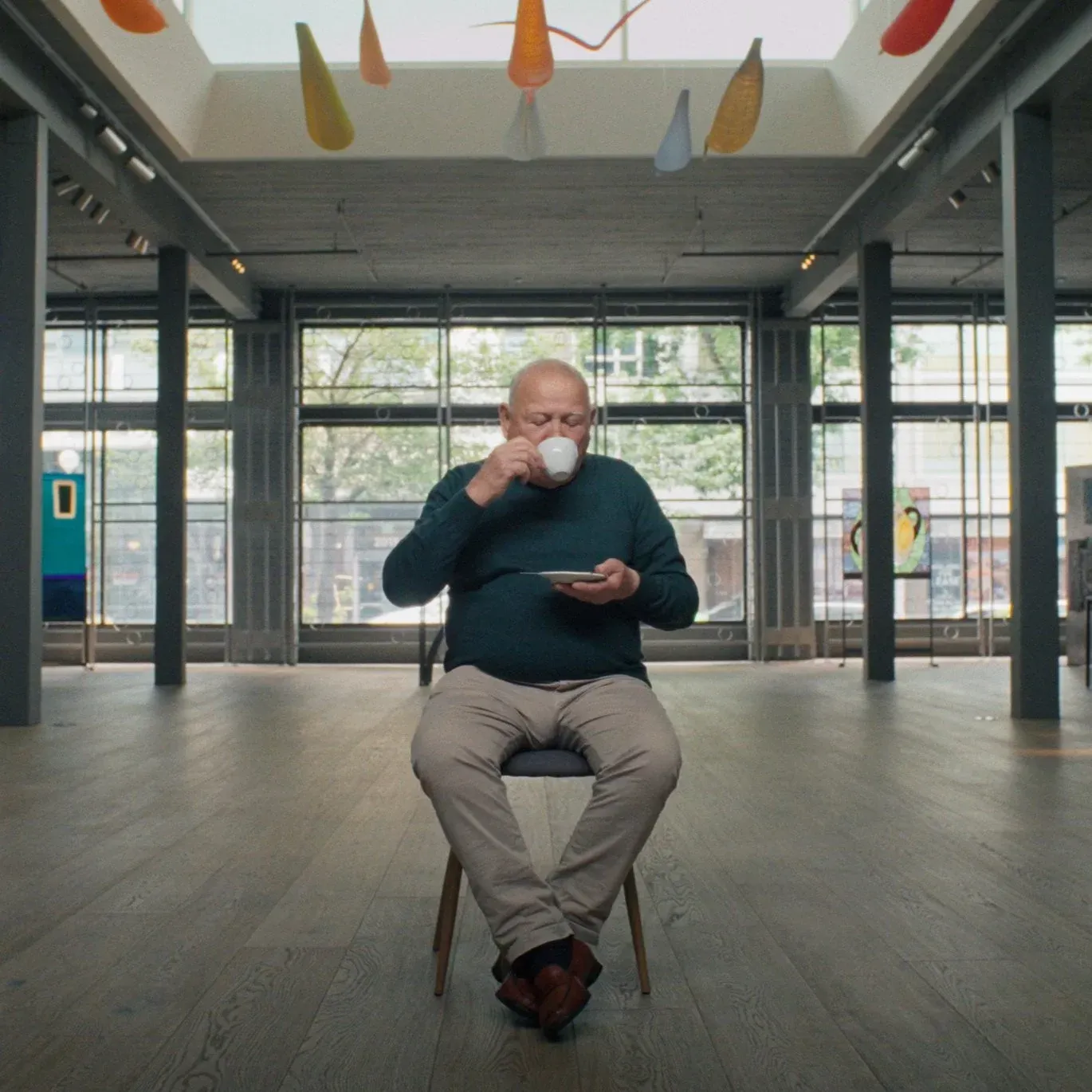
The phrase I use all the time is that I fell madly in love when I met him, and it’s true. I didn’t have much of an intention to pursue this particular project. I think there was a part of me that always wanted to do a proof of concept for this show idea, because I do think it’s an incredible show idea. But when I met him, I was blown away by how he feels in a room. It stood out to me not only that he was super ravenous about working at 86 years old – his general energy blew me away – but it's the way in which everyone around him spoke about him. The way people showed up for him, how people that have known him for 20, 30, 40, years are still around, and want to still be around Lino.
Then, we get locked down for the better part of two years. Then mid-2021 came around, and I was like, maybe I’ll do something completely independently. Maybe I'll do a pilot presentation or something like that with Lino, because I want to tell this guy's story. I've never felt so committed, like I was supposed to tell someone's story, as I did with this. I was pretty persistent when it came to that.
I remember I very bluntly pitched the family that I did not want to make a movie about Lino's glass at all. I was like, I don't mean to be crass, but I don't care that much about the result. You can go find his work anywhere. You can Google his work all over the world. You can go see it in galleries all over the world. I want to tell the story about the man, because I think he is the type of person, the way he moves through the world, the way that he has lived, that deserves to have their story told.
So I started following him around, and what I thought was going to be like a year turned into five years. I have an e-mail to Jacopo from like 2021 that says Maybe we’ll do one trip to Murano, and then a couple trips up to Seattle. 12 trips to Murano and 18 trips to Seattle later, I was like Okay, this ballooned a bit. But it turned out wonderful.
Wanting to tell the story about the man, not necessarily the work, you must have been thrilled when you asked him to introduce himself as a glass blower, and he refused and gave you the title of the movie instead, Sono Lino.
You know, it's funny, because he was really stubborn, not wanting to say he was a glass blower. That was like a three-year process of, like, Lino, my guy, you have to tell us the thing, introduce yourself in that way. But it was something he was super adamant about. And I remember when [editor] Lano [Medina] and I were going through the 70 hours of interview footage, and we were talking about what the name of the film could ultimately be. That's not the only time that we have Lino saying Sono Lino, he says that a bunch throughout the hundreds of hours of footage that we have. And I was like, I think that that should be the title. It's real. It isn't the story about the maestro. I guess it is just Lino, you know. So if he's adamant about saying I am Lino, then that's what we'll call it.
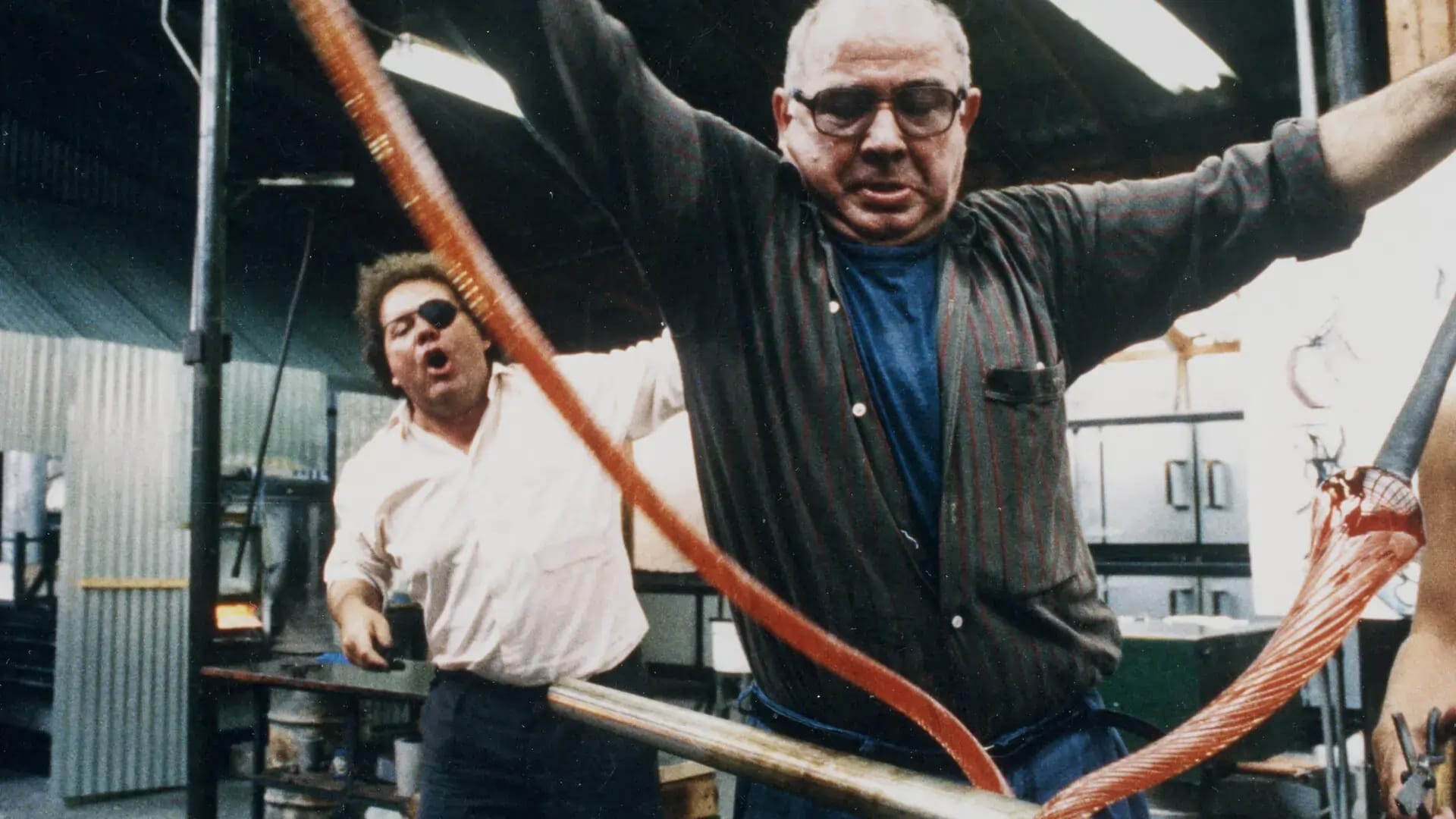
The thing I found most interesting about the movie is Lino's grounding as a laborer who turned into an artisan, and this fine line between those two roles. As a documentarian, you might be able to relate to that as well, because there's plenty of industrial films and other kinds of documentary filmmaking where people are generally considered laborers rather than artisans. I'm curious how this project and Lino might have changed how you thought about your work, or your role as an artist, or the distinction between laborers and artisans.
Lino is probably the most wholesome example that I've come across about why the artisanship of any craft is valuable.
We hear the glory stories from folks all the time. I think Christopher Nolan has said many times, Go shoot anything when you're young, shoot interviews and industrial videos and corporate stuff, all of that stuff matters. But there's always an element of, Yeah, you can say that because you just did Interstellar.
But the difference with craftsmanship specifically is those tools are never hidden. The technique you learn only through that type of unreal repetition being a grunt worker, really truly like a factory foreman, all that stuff is super evident, and why he's so good.
With this release, we have a bonus chapter that has never been seen before called Technica, and it's basically Lino talking through the importance of technique in a much more in-depth way. He talks about how if you don't have technique, you don't have freedom. Technique gives you the freedom that you need to create anything that you ultimately would want to create. Being around him so much, that's something that I've grown to appreciate about what it means to work professionally in my field. I deal with this dichotomy all the time, because I'm also the head of production and a director at a creative agency. I deal with that sort of corporate churn. Corporate blending is what I'll call it [laughs].
Lino changed my life in so many ways that he’s completely unaware of. His perspective on how fun it is to never stop learning. Because as long as you keep learning, you have the means to keep creating. I've just never known anybody that's 91 years old that still feels that way. The most full career of anyone I have literally ever met, with two distinct career chapters. He didn't just work as a foreman in Italy, he worked to retirement, he did his full career there, and then was like, Sweet, I'm glad I'm done with that. Let me go start my art career. That sort of true inspiration is incredibly profound to me. He is one of one in so many ways.
What’s next for you? Are you still playing around with the anthologies idea?
In a dream world, I can get this into a series, because of all of those relationships and the people that I connected with through development. Ironically, I think I learned through making this project that the original way we wanted to make that series is not possible. I would have to change that to make it a little bit more how Lino ended up coming out.
The project that just came out with Wild State [Chris Hemsworth’s production company, for whom Patrick just directed a documentary short series about Alzheimer’s called Memories Worth Protecting], I'm honestly blown away by the viewership. I really can't believe it. We’ve had millions and millions of impressions, and I think each episode has over a million views, which is crazy for a 10-minute episode of literally anything, but for something like this is really special. All the families have given us really wonderful responses to it too, and that's really all that matters.
As far as what’s next, I have a scripted feature that I’m trying to gear up to do next summer. But on the doc side of things, if I can make this show concept come to play, that would be huge. It’s called Makers, at least for now. If someone wants to make it, I’ll call it whatever they want.
And honestly, I’m going to put something out there that I have never said. I know that Apple Plus just got the rights to this, but I want to direct Lewis Hamilton's bio doc so bad. I so desperately want to do something in sport, and I feel like he, as a figure in the history of humankind, is somebody that I would absolutely love to be a part of sharing their story, and I feel that more so than ever after this very difficult season.
You mentioned a scripted feature, is there anything you can tease about it?
It’s ultimately a baseball movie. Lano, who is my editing partner, has been my creative collaborator for a long time and he’s my best friend of almost 20 years. It’s a semi-autobiographical film about his life. That film, and I don’t say this lightly, will probably be the best and most authentic elite level baseball ever put on film. He’s actually a professional level baseball player, and no one has ever starred in a movie with that type of talent. We have all of this other professional level baseball throughout, so that’s something I’m looking forward to. We’ve been championing this movie for over 10 years.

Jacob Patrick recommends: Sinners (and Lewis Hamilton's win at Silverstone in 2021)
My non-serious answer is I recently watched 2021 Silverstone. I just needed to feel Lewis come across the finish line first.
I feel like Sinners is such a cop out, because everybody's seen it like a million times, but I find myself going back to that movie a lot this year, because it's just so good. That movie inspires me in a new way every time I watch it. Ryan Coogler is one of my absolute heroes. I think he's a genius. I don't like horror movies at all, I don't watch horror movies at all, I definitely don't repeat watch horror movies at all. It's not my genre. I get nightmares too easily. Jump scares don't work well in my favor. I've watched that movie multiple times, so there's that.